
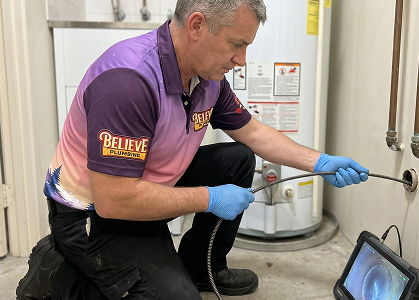
Short answer: A standalone sewer camera inspection typically runs somewhere around $250 to $800 in most markets, with more complex jobs involving line locating or difficult access reaching $1,000 or more. Those are typical market ranges rather than quotes. Many plumbers credit the inspection cost against a repair, and some run it at a reduced rate alongside a drain cleaning call, so it is worth asking. The inspection is almost always worth it before buying an older home, and before paying for any sewer repair, because it turns guesswork into a diagnosis.
A sewer camera is a waterproof camera head on a flexible push rod, fed down the line so you can watch what is actually in there on a screen. It answers a question that is otherwise pure speculation: what is wrong, and where.
What changes the cost
| Factor | Effect |
|---|---|
| Access | The big one. An existing cleanout is straightforward. No cleanout means going through a roof vent or pulling a toilet, which takes longer |
| Line length | Long runs from house to street or septic take more time |
| Whether the line must be cleared first | A camera cannot see through a solid blockage. If the line needs cleaning to pass the camera, that is added work |
| Locating | Marking the depth and position of a problem on the ground is often a separate charge, and often essential |
| Standalone vs bundled | Cheaper alongside another service than as a lone call-out |
| Emergency or after hours | Priced accordingly |
| Report and footage | Some include a recording and written report, some charge for it |
The cleaning point catches people out. If you call because the line is blocked, the camera may not be able to get past the blockage. Clearing it first is often necessary, which means the visit costs more than the inspection alone. That is not a bait and switch, it is the physical order of operations, but you should hear it up front.
When it is genuinely worth paying for
Before buying a house. This is the strongest case. A standard home inspection does not include a sewer scope. The sewer lateral, the pipe from the house to the main or the septic tank, is the homeowner’s responsibility, and replacing one is a serious expense. Spending a few hundred dollars to find out beforehand is straightforwardly good value, and it is far more compelling on an older property. Plenty of North Idaho housing stock is old enough that the original lateral is still in the ground.
Recurring backups. If a line has been snaked more than once in a year, snaking it a third time is treating a symptom. Something is causing it, and the camera tells you whether it is roots, a sag, a collapse, or something someone flushed.
Multiple fixtures acting up at once. One slow sink is a fixture problem. Toilets, tubs and floor drains misbehaving together points at the main line.
Before any sewer repair quote. Nobody should be quoting a dig without knowing where and what. If a contractor proposes excavation without having scoped and located the problem, ask why.
Before a remodel that adds fixtures or moves plumbing, so you know what you are tying into.
After heavy root season or ground movement. Which in this region is relevant, and we will come back to that.
What the camera can tell you
- Root intrusion, and how bad
- Bellies or sags, where the line has settled and holds standing water
- Offset joints, where sections have shifted apart
- Cracks, fractures and collapse
- Grease and scale buildup
- Foreign objects, including the genuinely surprising
- Pipe material, which matters enormously for what happens next
- Roughly where the problem is, and with a locator, precisely where and how deep
What it cannot tell you
Worth being straight about, because this is oversold.
- It cannot see through standing water well. In a belly holding water, the view is limited. That is a real constraint, not a bad technician
- It cannot measure remaining wall thickness. It shows the inside surface. It does not tell you how many years a corroded cast iron pipe has left
- It cannot always get through. Tight bends, a full blockage, or a collapse will stop the head
- It does not, by itself, mark the spot. Seeing a crack 47 feet down the line does not tell you where to dig. That needs a sonde, a transmitter in the camera head that a locator tracks from the surface to mark position and depth
- Interpretation varies. Two people can watch the same footage and describe it differently
Ask for the footage. A copy of the recording, and ideally a written report, means you can get a second opinion instead of taking one person’s word on a several-thousand-dollar excavation.
The North Idaho specifics
Pipe material and age. Older homes around Sandpoint, Coeur d’Alene, Post Falls and the surrounding communities can still have original clay tile laterals. Clay comes in short sections with joints at every one, and roots find joints. Some mid-century homes have Orangeburg, a bituminized fiber pipe that deforms and collapses with age and is bad news when a camera finds it. Cast iron corrodes from the inside. Knowing which one you have changes the entire repair conversation, and the camera is how you find out.
Trees. This is a heavily wooded region and root intrusion is the most common thing a sewer camera finds here. Roots do not attack sound pipe so much as exploit joints and small cracks where moisture escapes. Once in, they grow toward the water supply and form a mass that catches everything flushed past it.
Freeze and thaw. Ground that freezes and thaws through the season moves, and movement over decades is what opens joints and creates bellies. It is a slow contributor and it is real.
Septic versus sewer. A lot of properties out here are on septic rather than municipal sewer. A camera inspection of the line to a septic tank is still useful and works the same way, but tank condition, the drain field and the baffles are a separate assessment that a sewer camera does not cover. If you are buying a rural property, scoping the line is not a substitute for a septic inspection.
Getting value out of the money
- Ask what is included. Line clearing? Locating? Footage? A written report?
- Ask whether it is credited against a repair if one follows
- Ask where they will enter the line. No cleanout means more work, and it is worth knowing beforehand
- Insist on a copy of the footage
- On a home purchase, book it early in your inspection period, not on the last day
- If the recommendation is excavation, ask to see the located mark and the footage of the defect
If the answer to a serious problem is a full replacement, sewer line services covers what that involves. Often the answer is much smaller: a root cut and a maintenance plan, or a drain cleaning that resolves it. We wrote separately about the signs you need professional drain cleaning, which is the cheaper end of this conversation.
Frequently asked questions
How much does a sewer camera inspection cost?
Typical market ranges run around $250 to $800 for a standalone inspection, with complex jobs involving locating or difficult access reaching $1,000 or more. These are general market ranges rather than a quote. Many plumbers reduce or credit the cost when it is done alongside other work, so it is worth asking.
Is a sewer camera inspection worth it before buying a house?
For an older home, generally yes. A standard home inspection does not include a sewer scope, and the lateral from the house to the main or septic tank is the homeowner’s responsibility. Given what replacing one costs, a few hundred dollars to know in advance is reasonable insurance.
Can a sewer camera go through a blockage?
No. The camera needs a passable line, so a solid blockage has to be cleared before the camera can get past it. That is why a call that starts as an inspection sometimes needs drain cleaning first, and it should be explained to you before the work rather than after.
How do I know where the problem is after the inspection?
Through locating. A sonde transmitter in the camera head is tracked from the surface with a locator, marking the position and depth of the defect on the ground. Without it you know a problem exists somewhere down the line but not where to dig, so ask whether locating is included.
What does root intrusion look like on a camera?
Fine hair-like strands entering at a joint in the early stages, developing into dense masses that fill the pipe. Roots exploit existing joints and cracks rather than breaking through sound pipe, so finding roots usually means finding a joint or defect that let them in.
Should I get a camera inspection if my drains are working fine?
Generally not without a reason. The exceptions worth paying for are buying an older property, planning a remodel that changes the plumbing, or a history of repeat backups. Routine scoping of a healthy line is not necessary.
Find out what is actually in the line
If your drains keep backing up, or you are buying a place and want to know what you are inheriting, we will put a camera down it and show you what is there rather than guessing from the symptoms.
Call Believe Plumbing at (208) 690-4948 or get in touch. Our sewer camera inspection and location service covers Sandpoint, Coeur d’Alene, Post Falls, Hayden, Rathdrum, Priest River, Bonners Ferry and the wider North Idaho area.
Fast. Honest. Local. That’s Believe Plumbing.
Having water heater trouble as well? Start with tankless water heater troubleshooting.